KTG Property Solutions, Inc.
Timothy Cooprider
📞 561-756-2145
📍 231 Bradshaw Blvd, Perry, FL 32348
Timothy Cooprider
📞 561-756-2145
📍 231 Bradshaw Blvd, Perry, FL 32348
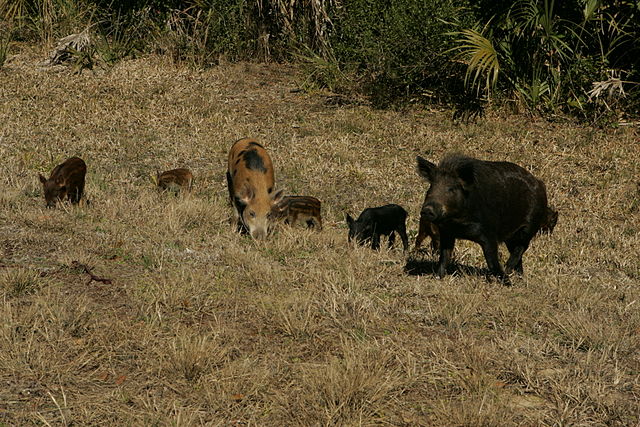
Feral pigs, also known as wild hogs, feral swine, or wild boar, are NOT native to Florida and are considered one of the most destructive and damaging invasive species in the state and throughout the United States. These animals are descendants of domestic pigs (Sus scrofa) that either escaped from farms or were intentionally released for hunting purposes, along with European wild boar that were imported and released in various locations beginning in the early 1900s. Feral pigs are highly variable in appearance due to interbreeding between different pig breeds and wild boar, ranging in weight from 75 pounds to over 400 pounds, with some exceptional individuals exceeding 500 pounds. Their coloration varies widely and includes solid black, brown, white, red, spotted, or any combination of these colors. They have coarse bristle-like hair, a muscular build, and adult males (boars) develop prominent curved tusks that can grow several inches long and are used for fighting and rooting. Feral pigs are extremely intelligent animals—comparable to dogs in cognitive ability—and highly adaptable omnivores with an acute sense of smell estimated to be three times better than that of dogs. They are social animals that typically travel in groups called sounders, consisting of related adult females and their offspring, while mature males are often solitary except during breeding season. As a highly invasive species with no natural predators in Florida, feral pigs cause billions of dollars in environmental and economic damage nationwide, with Florida being one of the most heavily impacted states.
Feral pigs are remarkably adaptable invasive animals that can thrive in virtually any habitat that provides food, water, and cover, making them particularly problematic for Florida's diverse ecosystems. While they show preference for areas with dense vegetation such as swamps, marshes, bottomland hardwood forests, and agricultural lands, they successfully colonize nearly every environment type. These destructive invasive animals require daily access to water for drinking and wallowing—a behavior essential for regulating body temperature since pigs lack functional sweat glands—and for controlling external parasites. Feral pigs create extensive networks of trails, wallows (muddy depressions), and rooting areas where they aggressively dig and tear into the soil with their strong snouts and tusks, searching for roots, tubers, insects, reptiles, amphibians, and other food sources. They often establish bedding areas in thick brush or under dense canopy cover where sounders rest during the day before emerging at night to forage. In Florida, feral pigs have successfully invaded and damaged virtually every habitat type including pine flatwoods, oak hammocks, river swamps, freshwater marshes, coastal areas, agricultural fields, ranchlands, and increasingly, the edges of suburban developments. Their ability to consume nearly anything edible—from plant matter and crops to small animals, bird eggs, fawns, sea turtle eggs, and even carrion—allows them to exploit a wide range of environments that native species cannot. Unlike native wildlife that evolved as part of Florida's ecosystems, feral pigs create catastrophic habitat destruction through their aggressive rooting behavior, which completely transforms and degrades landscapes, destroys native plant communities, causes severe soil erosion, contaminates water sources, and eliminates habitat for native wildlife.
Feral pigs possess several distinctive traits that make them particularly dangerous and problematic as one of the world's most destructive invasive species. They are among the most prolific breeders of all large mammals, capable of reproducing year-round with females (sows) potentially producing two litters annually of 4 to 12 piglets each, though litters of 6-8 are most common. Sows can breed as early as 6-8 months of age, and this exceptional reproductive capacity allows feral pig populations to increase by 60-80% per year under favorable conditions—meaning a population can triple in just five years even with significant harvest rates. Feral pigs have an exceptional sense of smell, estimated to be seven times more sensitive than the best bloodhounds, which they use to locate food buried up to three feet underground. Despite their bulk, they are surprisingly fast runners capable of reaching speeds up to 30 miles per hour, and are strong swimmers able to cross wide rivers and even swim several miles between barrier islands, allowing them to spread to new areas. Feral pigs can carry and transmit at least 34 diseases to humans, livestock, and native wildlife, including brucellosis, pseudorabies, leptospirosis, trichinosis, E. coli, salmonella, and various parasites including ticks that transmit Lyme disease. Their aggressive rooting behavior, where they use their muscular snouts and sharp tusks to violently tear up soil in search of food, can excavate areas up to several feet deep and destroy entire acres of land, crops, or natural habitat in a single night. This extraordinarily destructive feeding behavior is unlike anything exhibited by native Florida wildlife and contributes to massive soil erosion, water quality degradation through sediment and bacterial contamination, destruction of rare native plant species, elimination of ground-nesting bird habitat, and disruption of entire ecosystems that took thousands of years to develop.
The expansion of residential development throughout Taylor County and surrounding Florida areas has created severe and escalating challenges regarding feral pig populations and the catastrophic damage they cause. As a highly destructive invasive species, feral pigs were already causing extensive environmental and agricultural damage estimated at hundreds of millions of dollars annually in Florida alone, but urban sprawl has dramatically intensified human-wildlife conflicts and expanded the scope of destruction. Subdivisions built on the edges of rural and forested areas often find themselves directly in the path of feral pig movements, feeding ranges, and the extensive damage these animals cause. These invasive animals are responsible for some of the worst property damage homeowners can experience, routinely destroying entire yards, lawns, and landscaping overnight as they root up soil in their relentless search for grubs, earthworms, and roots. Feral pigs can tear up thousands of square feet of expensive sod and landscaping in a single night, leaving properties looking as if they were plowed by machinery, with deep furrows, overturned soil, destroyed irrigation systems, damaged trees, and completely ruined ornamental plants. The financial impact on homeowners can reach tens of thousands of dollars for lawn replacement, landscaping repair, and irrigation system fixes. Beyond property damage, feral pigs pose serious safety concerns as they can be extremely aggressive when cornered, protecting young, or startled, and their size, strength, and sharp tusks make them genuinely dangerous to pets, livestock, and potentially to humans, particularly children. There have been documented cases of feral pigs attacking dogs, killing cats, and even charging humans who encounter them unexpectedly. Agricultural operations near developing areas suffer absolutely devastating losses as feral pigs damage and destroy crops (including peanuts, corn, soybeans, melons, and vegetables), tear up pastures, destroy fences, contaminate livestock feed, prey on newborn livestock, and spread diseases to domestic animals. The compression of habitat has not deterred these prolific invasive animals—in fact, their populations continue to expand rapidly despite development because they exploit both natural areas and human-provided food sources including garbage, pet food, crops, and livestock feed. Unlike native species whose populations are naturally controlled by habitat availability and predators, feral pig populations in Florida have no natural controls and continue to increase exponentially. Their presence causes catastrophic economic losses through extensive property damage, complete crop destruction, livestock losses, infrastructure damage, disease transmission risks, and severe environmental degradation to Florida's irreplaceable native ecosystems. Management, control, and removal of these highly invasive and destructive animals is absolutely critical and often urgent to prevent further spread, protect land values, safeguard agricultural interests, ensure public safety, and protect Florida's native ecosystems and wildlife from the devastating impacts these invasive pigs cause. Professional removal is often necessary when feral pigs establish themselves in an area, as their populations grow rapidly and the damage they cause increases exponentially over time. In many cases where damage is severe or populations are established, lethal removal may be necessary as part of comprehensive management to protect property, agriculture, native wildlife, and public health.
Contact KTG Property Solutions for professional assessment and removal services.
Request Service